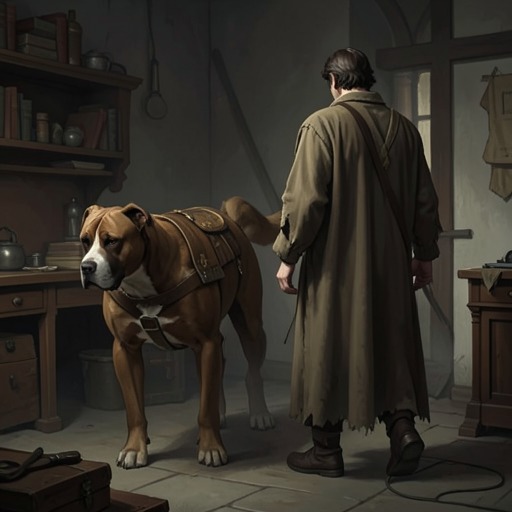
John Carter and Woola
A Princess of MarsJohn Carter and Woola form a bond that turns imposed guardianship into reciprocal loyalty. Woola first watches Carter because Sola commands him to do so, but his repeated acts of protection—and Carter’s refusal to abandon or surrender him—make the relationship one of the clearest expressions of affection and compassion in Carter’s life on Mars.
From Guard to Rescuer
When Sola leaves Carter alone in his chamber, Woola crosses to the street-facing exit and lies across the threshold, keeping watch. Carter is initially uncertain what the fearsome creature might do, but Woola does not threaten him. He guards Carter throughout his captivity among the green Martians, never voluntarily leaving him and twice saving his life.
The bond is tested when a great white ape attacks Carter. Woola hurls himself at the attacker, giving Carter the chance to escape, and the two animals struggle until Woola is gravely weakened. Carter considers flight, but the sight of his fallen guardian changes his decision: he stays to help rather than leave the creature that has just protected him. After distracting and defeating the ape, he turns to the injured Woola instead of treating him as a disposable guard.
The danger continues even after the fight. When a warrior raises a pistol to kill the recovering Woola, Carter intervenes and knocks the weapon aside. He then helps Woola to his feet and signals for him to follow. Tars Tarkas permits Carter to leave with the animal, and Woola returns to the plaza at his side. Carter recognizes that the relationship has become more than a practical arrangement: he regards Woola as a friend whose loyalty calls for loyalty in return.
Trust Freely Given
Carter later tests whether Woola will obey his duty to keep him within the city or respond to their personal attachment. At the boundary, Woola runs anxiously ahead and presses against Carter’s legs, pleading rather than threatening him. Carter answers not with force but with affection: he sits down, puts his arms around Woola’s neck, strokes him, and speaks in Martian as he would to a familiar hound at home.
Woola responds with exuberant play. Carter laughs at the animal’s antics, then remembers that laughter on Mars signifies suffering and quiets himself when Woola becomes frightened. He reassures Woola before commanding him to follow. From that point, Carter describes Woola as his devoted follower and himself as Woola’s undisputed master. Yet the new obedience is not simply a return to the original guard arrangement: it follows a moment of affection, and Woola’s earlier pleading shows that he has a will and attachment of his own.
The change gives Carter a limited freedom within captivity. Tars Tarkas had relied on Woola to keep him from leaving the city, but Woola now accompanies Carter beyond the boundary. Carter returns before the defection can be discovered, knowing that discovery could curtail his own liberty and endanger Woola. Their closeness therefore offers both companionship and a new risk: protecting the bond also means keeping it out of the notice of Woola’s former masters.
Kindness as a Practice
Carter carries what he learns with Woola into his treatment of the thoats. Rather than rely on the customary blows used to control the powerful mounts, he first establishes that they cannot unseat him, then gradually wins their confidence. Within days they follow him, nuzzle him, and respond readily to his commands. The contrast matters in practical as well as emotional terms: Carter argues that animals who trust their rider will obey in battle and on the march, making kindness compatible with, and useful to, a warrior’s effectiveness.
Woola is thus central to a broader challenge Carter poses to the green Martians’ harsh habits. His example demonstrates to Carter that an animal can answer care with affection and loyalty; Carter in turn treats those qualities as worthy of protection rather than as weaknesses. The relationship does not erase the difference in their positions—Carter calls himself Woola’s master—but it gives that authority a different basis from mere force.
Loyalty Across Separation
The bond remains active when Carter is separated from Woola. After a long, exhausting journey with Sola and Dejah Thoris, Carter wakes in the wilderness to find the hound beside him. Woola has followed the party across trackless country to share their fate. Carter embraces him, moved by the animal’s devotion; the reunion offers companionship at a moment when the travelers are lost and exhausted.
Later, while Carter searches alone for a waterway, a large creature pins him down. Woola suddenly arrives and rescues him. Carter recognizes him by the moonlight, but cannot tell how he found him or where he has come from. Seeing that Woola is severely weakened and hungry, Carter understands that the hound has endured hardship to stay with him. Woola eats the dead creature, then Carter resumes his search with him at his side.
Across these scenes, loyalty is not presented as a single act of trained obedience. Woola guards Carter, returns after separation, and repeatedly risks himself for him; Carter answers by refusing to abandon him, defending him from execution, offering affection, and extending kindness to other animals. Their companionship makes emotional reciprocity visible in a society Carter experiences as starved of compassion, and it gives the hound a continuing role as an agent in his survival rather than a mere possession or weapon.